
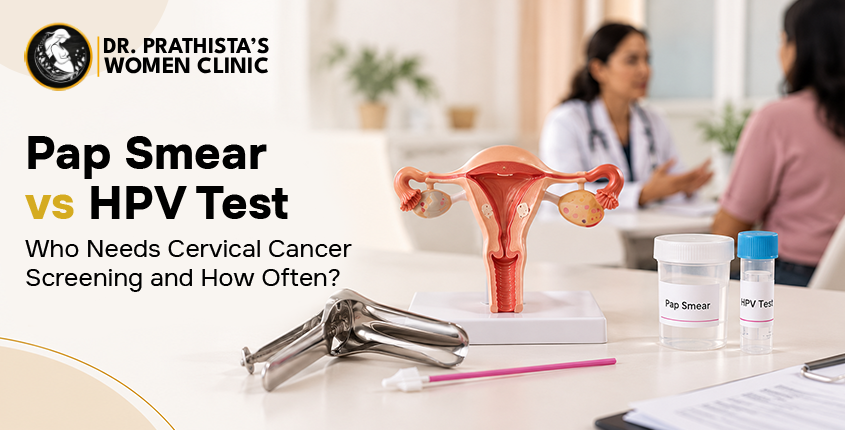
Cervical cancer is one of the few cancers that can be largely prevented, and when abnormal changes are found early, they are far easier to treat. The catch is that the early stages usually cause no symptoms at all. That is why screening, which means testing healthy women before any problem appears, is so valuable.
If you have heard terms like Pap smear, HPV test, VIA and colposcopy and are unsure what applies to you, this guide explains them in plain language.
Note: This article is for general health education and is not a substitute for a personal medical examination.
What causes cervical cancer?
Almost all cervical cancers are linked to long-lasting infection with certain high-risk types of the human papillomavirus (HPV). HPV is very common and spreads through skin-to-skin genital contact. Most people clear the virus on their own within a couple of years. In a small number of women, the infection persists and slowly causes changes in the cells of the cervix. Without detection, these changes can progress to cancer over many years, often a decade or longer.
Factors that raise the risk of persistent infection or progression include:
- Early sexual activity or multiple sexual partners (for the woman or her partner)
- Weakened immunity, including HIV infection
- Smoking or tobacco use in any form
- Long-term use of certain hormonal medicines
- Not having been screened regularly
Having a risk factor does not mean you will develop the disease, and having no risk factor does not remove the need for screening.
Pap smear vs HPV test: what is the difference?
Both tests collect cells from the cervix in a quick outpatient procedure, but they look for different things.
| Pap smear (cervical cytology) | HPV test (HPV DNA test) | |
|---|---|---|
| What it checks | Looks at cervical cells under a microscope for abnormal changes | Detects the presence of high-risk HPV types |
| What it tells you | Whether cell changes are already present | Whether you carry the virus that can cause those changes |
| Typical interval | Often every 3 years, as advised by your doctor | Often every 5 years if the result is negative, as advised by your doctor |
| Can be done together? | Yes, called co-testing, commonly for women above 30 | Yes |
Another method you may hear about is VIA (visual inspection with acetic acid), where the cervix is examined after applying dilute acetic acid. It is used in public health programmes where laboratory facilities are limited.
The World Health Organization now recommends HPV testing as a preferred primary screening method because it identifies risk earlier than cell changes become visible. The choice of test for you depends on your age, health history, previous results and what is available, so your gynaecologist will guide you.
Who needs cervical cancer screening?
Guidelines differ slightly between organisations, so treat the following as a general framework and not a personal prescription:
- Women from about 25 to 30 years of age who are or have been sexually active are usually advised to begin screening, with the exact starting age depending on the programme or guideline followed.
- Women aged 30 to 65 are the group in whom screening is most strongly recommended, using an HPV test, a Pap smear, or both, at the intervals advised.
- Women living with HIV or with weakened immunity are advised to start earlier and screen more often.
- Women who have had the HPV vaccine still need screening, because the vaccine does not cover every high-risk type.
- Women past 65 may stop only if they have had consistently normal results and a doctor confirms it.
- Women who have had a hysterectomy may not need screening if the cervix was removed for a non-cancerous reason, but this should be confirmed with the doctor.
If you have never been screened, or you do not remember when your last test was, it is a good time to ask.
Symptoms that should not wait for a screening date
Screening is for women without symptoms. If you notice any of the following, see a gynaecologist promptly instead of waiting for your next routine test:
- Bleeding between periods
- Bleeding after intercourse
- Any vaginal bleeding after menopause
- Unusual, persistent or foul-smelling vaginal discharge
- Pain in the pelvis or during intercourse
These signs do not always mean cancer. They have many common causes, but they do need to be evaluated.
How to prepare for a Pap smear or HPV test
The test takes only a few minutes. To make sure the sample is accurate:
- Schedule it when you are not menstruating. The days in the middle of your cycle are generally best.
- Avoid intercourse, douching and vaginal medicines or creams for 24 to 48 hours before the test, unless your doctor has told you otherwise.
- Tell the doctor if you are pregnant, may be pregnant, or have recently given birth.
- Wear comfortable clothing and feel free to ask questions before you begin.
What happens during the test?
You lie on an examination table. A speculum is gently placed in the vagina so the cervix can be seen. A small brush or spatula collects cells from the cervix, which are sent to the laboratory. You may feel mild pressure or a brief cramp, but the procedure should not be severely painful. Tell your doctor straight away if you are uncomfortable, and the process can be adjusted.
Understanding your results
- Normal or negative: No abnormal cells or high-risk HPV were found. Continue screening at the interval your doctor advises.
- HPV positive with normal cells: The virus is present but has not caused visible changes yet. Your doctor will usually plan a repeat test or closer follow-up.
- Abnormal cells (for example ASC-US, LSIL, HSIL): The cells show changes of varying degree. This does not mean cancer. Further evaluation, often a colposcopy (a magnified examination of the cervix) with a small biopsy if needed, helps decide the next step.
- Unsatisfactory sample: The sample could not be read, and a repeat test is needed.
Most abnormal results are caught at a stage where simple treatment can remove the affected area and prevent cancer from developing.
HPV vaccination: a useful addition, not a replacement
The HPV vaccine protects against the most common high-risk virus types and is most effective when given before exposure to the virus, which is why it is recommended in early adolescence. Girls and young women should discuss eligibility and schedules with their doctor or paediatrician. Parents who would like guidance on a young girl’s health needs can look at the clinic’s adolescent and geriatric gynaecology care page. Vaccinated women should still follow the screening schedule.
Healthy habits that support cervical health
- Avoid tobacco in every form
- Use barrier protection such as condoms, which lowers (but does not eliminate) the risk of HPV transmission; for choices that suit your life stage, explore family planning counselling
- Keep up with routine gynaecology check-ups, including during and after pregnancy; see our antenatal care information for what to expect
- Complete vaccination as advised by your doctor
Frequently asked questions
Is a Pap smear painful?
Most women feel mild pressure or a short cramp. It is not usually painful, and it lasts only a few minutes.
At what age should I start Pap smear tests?
Guidelines commonly suggest starting between 21 and 30 depending on the programme, with 30 being the age from which HPV-based screening is most widely recommended. Your doctor will advise you based on your history.
Can I get a Pap smear during pregnancy?
Yes. A Pap smear is considered safe in pregnancy, and it is often done as part of early antenatal evaluation if you are due for screening.
Does a positive HPV test mean I will get cancer?
No. Most HPV infections clear by themselves. A positive result simply means you need closer follow-up so that any changes can be found and treated early.
Do I still need screening if I have only one partner or am not currently sexually active?
Yes, if you have ever been sexually active. HPV can remain in the body for years without any signs, so the screening schedule continues.
How long do the results take?
Depending on the laboratory, results are usually available within a few days to about two weeks.
Book your cervical screening in Karimnagar
Regular screening takes only a few minutes and can protect you for years. Dr. Prathista Clinic offers cervical cancer screening and evaluation at Sharma Nagar, Karimnagar. You can book an appointment, find the clinic details on the contact page or call +91 832 814 3834. To read about the doctor, visit the profile of Dr. Prathista Rao, and for more reading, see the clinic blog.